Following its delivery of 43,123 tonnes of carbon dioxide equivalent in Phase 1 carbon credits — the largest single handover of credits from forest conservation and restoration projects in Thailand to date — the Mae Fah Luang Foundation under Royal Patronage (MFLF) is continuing to advance its community-centred forest carbon-credit model.
The credits were generated under the “You Look After the Forest, We Look After You: Forest Carbon Credit Management for Sustainable Development” programme, which has operated since 2021 and initially covered 12 projects in four northern provinces.
They were transferred to seven private-sector organisations during the MFLF Sustainability Forum 2025, held under the theme “Global Challenges, Local Solutions at Scale” at the Queen Sirikit National Convention Center in Bangkok in September 2025.
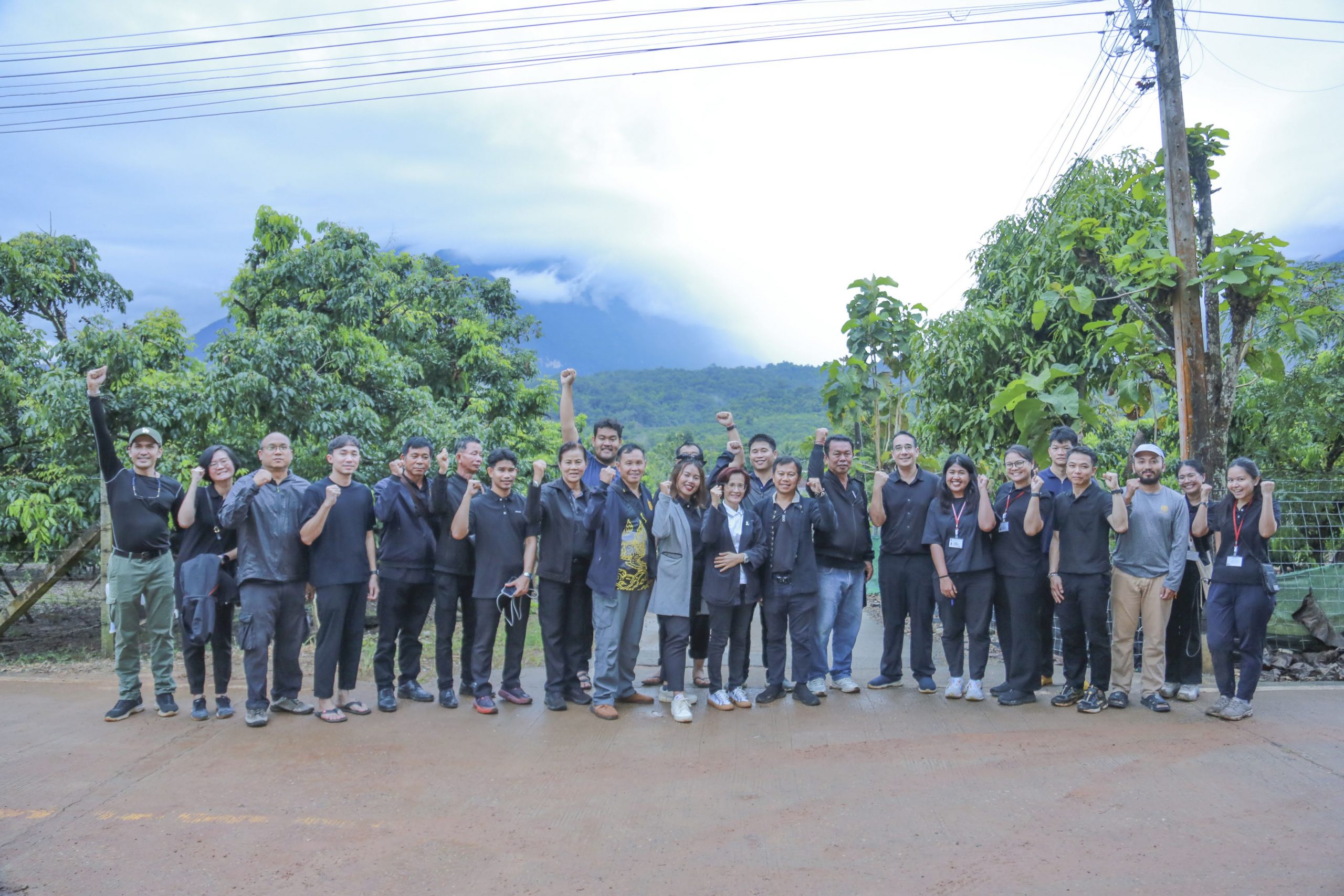
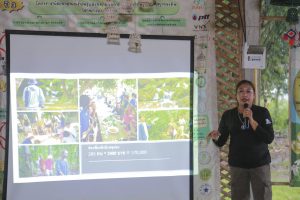
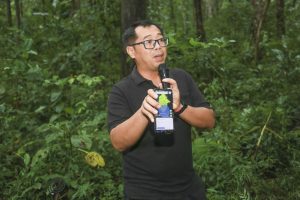
More recently, the Foundation organised a field visit to the Forest Carbon Credit Management for Sustainable Development programme, accompanied by discussions with representatives of community-forest networks in northern Thailand.
The visit highlighted the economic, social and environmental outcomes of participatory forest management over the past five years.
The programme has expanded to more than 300 community forests covering over 287,000 rai nationwide. It has significantly reduced areas damaged by wildfires in its earliest project sites and channelled more than 157 million baht into community-managed funds.
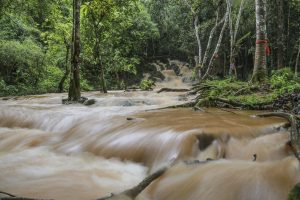
The visit also showcased Ban Hua Thung in Chiang Dao district, Chiang Mai, as a case study. Located within the Doi Chiang Dao Biosphere Reserve, the community is home to Nam Ok Hu, a water source connected to the Ping River basin.
Led by a woman village head, the community has demonstrated how forest stewardship can become a legitimate, transparent, measurable and verifiable source of employment. Its work generates shared value for the public sector, businesses and communities while supporting Thailand’s net-zero and biodiversity-conservation goals.
Community-centred carbon credits
Smitthi Harueanphuech, Head of Nature Based Solutions & Special Projects at the Mae Fah Luang Foundation, said the programme had developed a community-centred carbon-credit model that addressed forest conservation and people’s livelihoods at the same time.
The initiative was launched in 2021 under the Thailand Voluntary Emission Reduction Program, or T-VER, administered by the Thailand Greenhouse Gas Management Organization (Public Organization), or TGO.
It builds on the “Planting Forests, Cultivating People” model developed through the Doi Tung Development Project, whose achievements have gained international recognition, and extends the approach to community forests across Thailand.
The programme now covers more than 287,000 rai managed by over 300 communities in 12 provinces across the North, Northeast, Central Plains and South.
More than 150,000 people participate in the programme, which is supported by over 30 private companies and state enterprises.
Field-based indicators demonstrate tangible results. In project areas participating in Phases 1 and 2, the proportion of land damaged by wildfires fell from an average of 12% to 4% in 2024. In Phase 3 areas, the figure declined from 8% to 3%.
The results reflect the effectiveness of year-round community forest management, both during and outside the annual fire season.
Communities own the rules, data and benefits
The programme is built around the principle that communities should own “the rules, the data and the benefits”.
Financial support from programme partners and carbon-credit buyers is channelled to villages through two funds.
The Forest Stewardship Fund supports conservation, forest restoration and wildfire prevention and mitigation. Activities include constructing firebreaks, conducting patrols, building check dams and planting or restoring forests.
The Sustainable Development Fund supports grassroots livelihoods and helps reduce pressure on natural resources.
More than 157 million baht has circulated through the two funds. Participating communities develop their own plans, submit project proposals, monitor implementation and report the results.
The Foundation serves as a technical mentor, providing support on standards, measurement, reporting and verification, or MRV, as well as governance.
This structure helps turn forest stewardship into legitimate employment that improves people’s quality of life while extending the life and ecological integrity of the forests.
Transparent and verifiable data
To ensure the quality and integrity of the carbon credits, the programme uses field sample plots established in accordance with T-VER requirements.
Field data are combined with interpreted imagery showing forest types and canopy density. Conditions at the beginning of each project are compared with those recorded after participation to assess carbon sequestration and avoided greenhouse-gas emissions in community forests.
The process makes the information transparent and independently verifiable while creating a foundation for future carbon-credit certification.
It also preserves a central principle of the programme: the people who perform the work should receive a fair share of the benefits.
Ban Hua Thung: a community within a biosphere reserve
Ban Hua Thung in Chiang Dao district provides a clear example of the model’s results.
The community is located within the Doi Chiang Dao Biosphere Reserve and is the source of Nam Ok Hu, which feeds into the Ping River system.
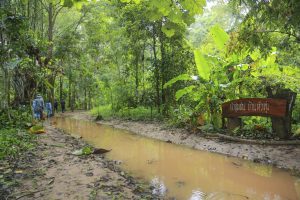
Ban Hua Thung joined the Foundation’s forest carbon-credit programme in 2022 and manages 883.93 rai of community forest. Its participation has produced tangible environmental benefits while strengthening the local economy.
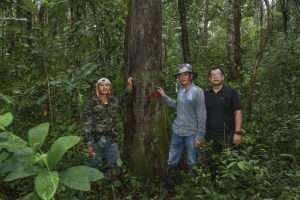
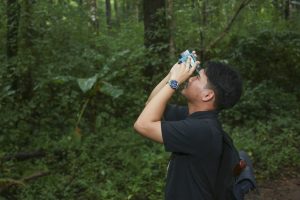
The work is led by Siriwan Sringoen, the woman village head of Ban Hua Thung, who has brought together community members of all ages and established clear roles and governance arrangements.
The community has introduced rules governing forest use, organised patrol schedules, constructed firebreaks and collected data from sample plots alongside technical teams.
These efforts have enabled the forest to recover continuously, significantly reduced wildfire risks and strengthened the security of the upstream ecosystem, generating benefits for communities throughout the Ping River basin.
Income from protecting forests
A defining feature of Ban Hua Thung is that local income is generated not by encroaching on forests, but by protecting them and adding value to traditional knowledge.
Funding from the programme has created employment in forest stewardship and supported the development of community products that add value to locally available resources.
Waste bamboo left over from basketry, for example, is converted into charcoal and subsequently developed into deodorising blocks, shoe trees, soap and toothpaste.
These activities provide supplementary income for older people, people with disabilities and disadvantaged members of the community.

The model has also been extended to five neighbouring villages, where communities have shared livelihood skills including mushroom cultivation, beekeeping, local food production and basketry.
The expansion gives younger residents opportunities to build careers in their home communities without placing additional pressure on forests. It also fosters a shared sense of pride in their role as “guardians of the watershed”.
Wider environmental benefits
The experience of Ban Hua Thung and its surrounding network demonstrates that proactive prevention can significantly reduce wildfires.
This lowers the risk of PM2.5 pollution caused by forest fires and prevents the loss of carbon stored in trees and soil.
Recovering forests also protect biodiversity and provide essential ecosystem services. These include absorbing rainfall, reducing soil erosion and maintaining the quality of the country’s water resources.
When upstream forests are healthy, natural-resource-based economies that depend on water become more resilient. The benefits extend to farmers, tourism operators and downstream towns requiring reliable supplies of clean water.
These are public benefits shared across the country, rather than benefits limited to buyers of carbon credits.
A fair incentive for conservation
From the perspective of community economics, carbon credits serve as a “fair incentive” rather than merely a mechanism through which companies offset their carbon footprints.
Prices in Thailand’s voluntary carbon market vary according to factors including the vintage year, the quality and integrity of the underlying data, and the terms agreed between buyers and sellers.
In carbon markets, the vintage year refers to the year in which the emissions reduction or carbon removal represented by a credit took place. It is one of several factors that can influence the trading price of the credit.
At the time of the programme’s field visit, publicly available reference prices for comparable credits were around 2,000 baht per tonne of carbon dioxide equivalent, although actual transaction prices depended on credit characteristics and individual agreements.
When credits are sold, the community’s share of the revenue is returned to the two funds to finance continuing forest-management employment and livelihood development.
This creates a cycle of “money, jobs and forests” within the community, enabling conservation activities to become financially sustainable over the long term.
The Forest Carbon Credit Management for Sustainable Development programme offers a tangible model of the kind of carbon-credit system Thailand is seeking — one firmly connected to the lives of local people.
It protects watersheds, creates employment, stimulates grassroots economies and provides cleaner air and water for the wider public.
Ban Hua Thung is therefore more than a successful community-forest case study in Chiang Dao. It demonstrates that when rules and incentives are designed fairly, carbon credits can become a bridge connecting healthy forests, a more equitable society and a sustainable economy — contributing to genuine total well-being.