“Waste Moves Forward” connects Bangkok’s approach with lessons from Doi Tung, alongside learning opportunities on urban forests and circular fashion
The Mae Fah Luang Foundation under Royal Patronage supported Bangkok Climate Action Week 2026 (BKKCAW 2026) with a programme of climate and sustainability activities from 3 to 11 October 2026. Covering waste management, biodiversity, urban green spaces and circular resource use, the activities were designed to show participants how climate issues connect with cities, workplaces and everyday life, while offering practical ideas they could apply in their own settings.
The Foundation also provided forest carbon credits from the Doi Tung Development Project to offset residual greenhouse gas emissions from the event and support its net-zero target. The programme featured a range of key activities.
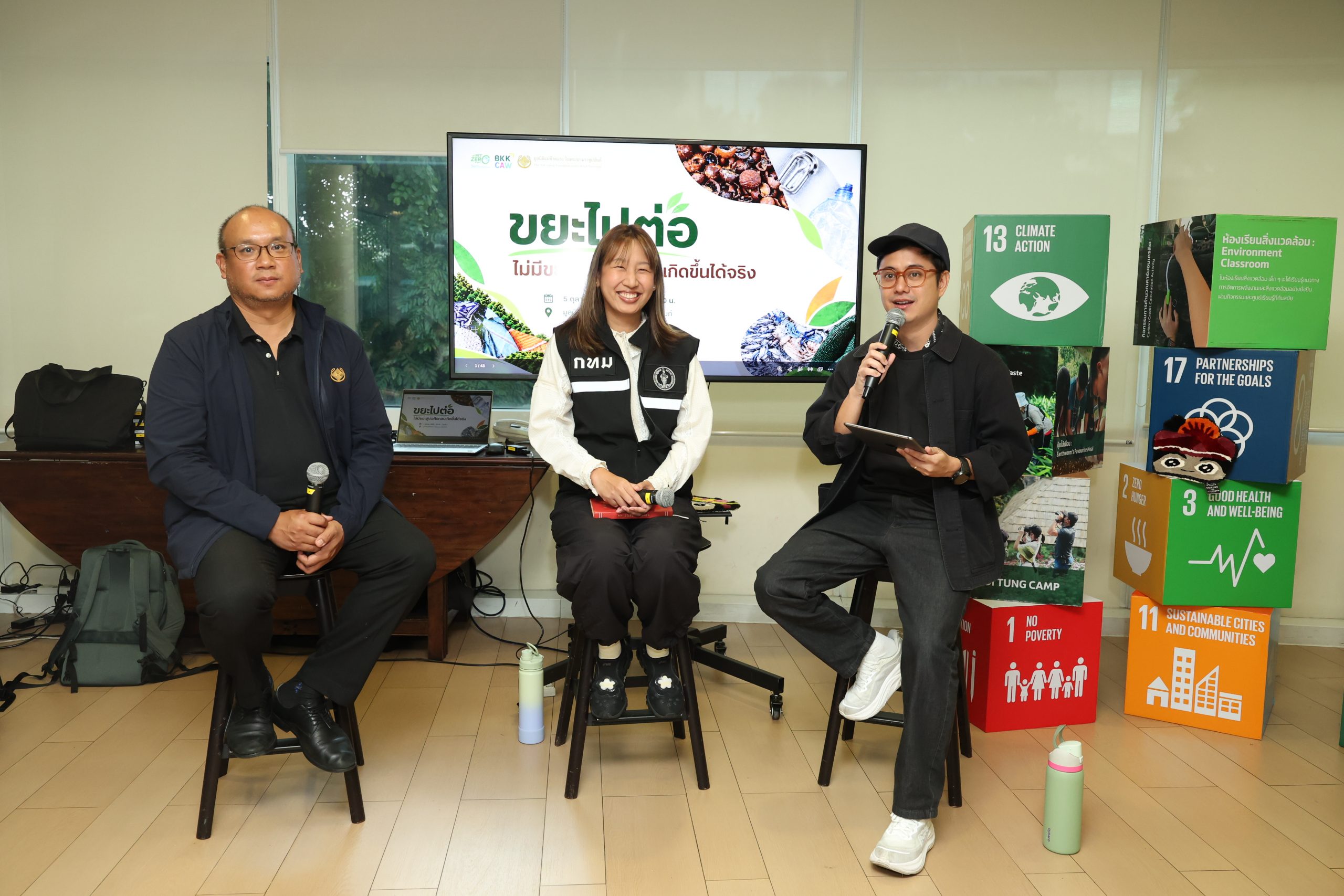
“Waste Moves Forward: Zero Waste to Landfill Is Possible” combined a workshop and panel discussion on integrated waste management, connecting the Bangkok Metropolitan Administration’s (BMA) approach with lessons from the Doi Tung Development Project. The session covered waste reduction and management at source, collection, and the delivery of each waste stream to an appropriate destination. It also presented examples that individuals, offices and organisations could adapt to their own circumstances.
Pappim Pimmarat, representing the BMA, and Dr Thanapong Duangmanee, representing the Mae Fah Luang Foundation, shared their approaches and experience. Chanut “Kong” Wudhiwigaigarn of KongGreenGreen moderated the discussion. Held on Monday, 5 October 2026, at the Foundation’s Bangkok office on Rama IV Road, the event attracted media representatives and other interested participants.
Pappim said reducing waste sent to landfill could not be achieved by any single party acting alone. It required a connected system spanning waste generation, collection and final treatment: reducing the amount of waste produced, separating it correctly, keeping waste streams separate during collection, and ensuring that each type reached an appropriate destination.
The BMA prioritises collaboration with residents, communities, office buildings, businesses and partner networks to improve everyday waste management practices. With a clear supporting system, people could see that separated waste could “move forward”, whether through recycling, the recovery of organic waste or other forms of resource recovery.
She stressed that waste management involved more than adding bins or campaigning for people to sort their rubbish. People needed confidence that separated waste would not be mixed together again, with clearly assigned responsibilities at every stage. Building understanding and trust was therefore central to sustaining participation among individuals and organisations.
“Bangkok is committed to advancing the Bangkok Reduce – Bangkok Reuse initiative, which aims to reduce plastic waste by 100 million items by cutting the use of disposable packaging, encouraging reuse and promoting environmentally responsible event practices,” Pappim said.
Dr Thanapong shared experience from the Doi Tung Development Project (Royal Initiative), which has maintained zero waste to landfill since 2018. Its system began with an assessment of waste types, quantities and sources. The findings were then used to design collection arrangements, assign responsibilities and identify suitable destinations for each waste stream. This was accompanied by efforts to build understanding among users and operational staff, alongside continuous data collection, monitoring and system improvements.
Doi Tung’s approach can be adapted to private-sector offices in Bangkok, where large numbers of people share resources and generate waste each day. Those involved range from executives, employees and cleaning staff to building managers, contractors and downstream material handlers. Office waste management must therefore address both systems within the building and the transfer of waste to external partners. This prevents separated waste from being mixed again in transit and ensures that each material is put to use or managed appropriately.
Dr Thanapong cited floors 20–25 of WHA Tower as a case study in applying Doi Tung’s knowledge through the Foundation’s sustainability consultancy work. Over eight months, from January to August 2026, the Foundation helped assess waste types, quantities and routes before establishing a system for four waste streams: biodegradable waste, recyclables, waste for refuse-derived fuel (RDF) production, and hazardous waste.
The work also included connecting with downstream partners, establishing an internal committee, training employees and cleaning staff, preparing a standard operating procedures manual, and developing a monitoring system.
The results showed that no waste from the project area was sent to landfill. The recycling rate rose to 66.96%, exceeding the 50% target, while greenhouse gas emissions were reduced by 7.7 tonnes of carbon dioxide equivalent.
Employees and operational staff also improved their waste management practices, with some adopting the approach at home. The results demonstrated how organisations could start with a pilot area, use data to improve their systems and build staff capacity to continue managing operations independently.
The event also included a workshop in which participants practised sorting waste and developed waste management plans for their own premises. They learned about the six categories used by the Foundation: recyclable materials, biodegradable waste, soiled waste, waste for RDF production, bathroom waste and hazardous waste.
Participants analysed the sources and quantities of each waste type, collection methods, responsible personnel and final destinations. They then used this information to develop management plans suited to their homes, offices or organisations. The workshop emphasised that waste categories and management methods must reflect the waste actually generated and the destinations available to receive it, enabling participants to put their learning into practice.
The Foundation also hosted “Microforests in the City: Rethinking Green Spaces for People, Climate and Biodiversity” on 5 October 2026, from 2pm to 5pm, at its Rama IV office. Drawing on the CDL MicroForest case study in Singapore, the session explored how to design, maintain and measure the outcomes of small urban forests.
Speakers included Adrian Loo Hock Beng, Priscilla Tan and Supawut Boonmahathanakorn, representing the National University of Singapore (NUS), City Developments Limited (CDL) and Wewilding, respectively.
They shared approaches to site selection, the design of forest structure and plant species composition, maintenance, and the collection of biodiversity and local microclimate data. A workshop then invited participants to design a microforest for a simulated 500-square-metre site in Bangkok. The aim was to develop practical concepts that could be tested and further developed for building projects, commercial spaces and public areas.
The programme also featured “Every Shade of Fashion”, a discussion organised by Kamonnart Ongwandee from DOITUNG EVERYDAY, together with Amorpol Huvanandana from Moreloop and Cavina Willson from Sustainable Fashion Week UK.
The discussion explored perspectives and practical approaches to advancing a fashion industry that uses resources more efficiently, reduces surplus materials and waste, and offers more socially and environmentally responsible fashion choices.
All activities were designed to show participants the connections between climate, cities, workplaces and everyday life, while providing ideas they could put into practice.