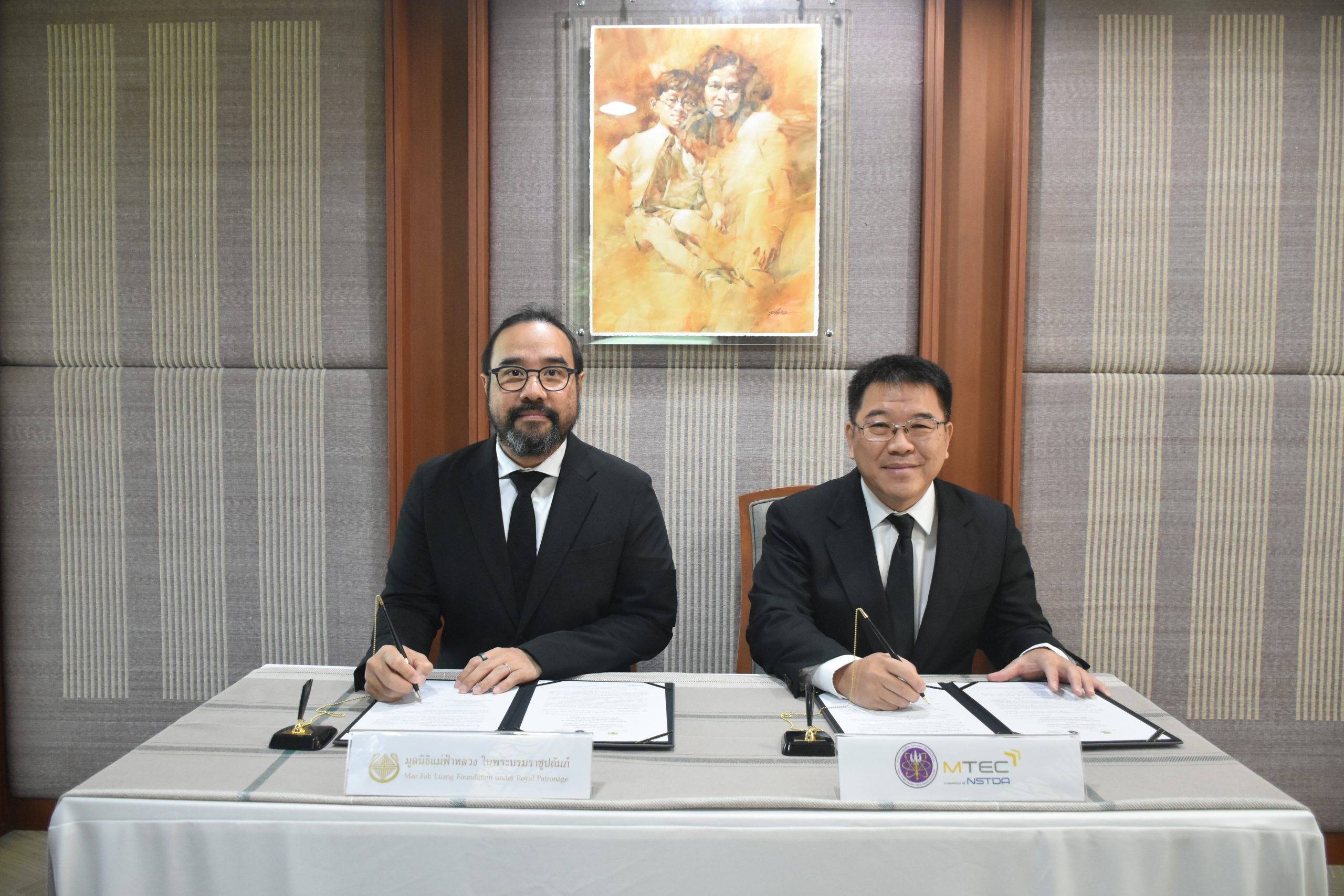
BANGKOK, June 22, 2026 — The National Metal and Materials Technology Center (MTEC), under the National Science and Technology Development Agency (NSTDA), and the Mae Fah Luang Foundation under Royal Patronage (MFLF) have signed a memorandum of understanding to develop a community-level pilot project producing biochar from agricultural residues.
The agreement, signed at the MFLF’s Bangkok office, aims to promote the sustainable management of agricultural residues, reduce air pollution and create new economic opportunities for local communities.
The signing ceremony was attended by M.L. Dispanadda Diskul, Secretary-General and Chief Executive Officer of the MFLF, and Assoc. Prof. Dr. Toemsak Srikhirin, Executive Director of MTEC, together with executives and project teams from both organisations.
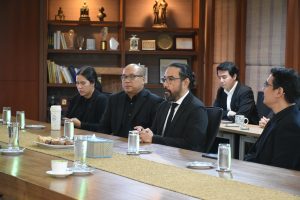
Assoc. Prof. Dr. Toemsak said the partnership would bring MTEC’s expertise and technologies in materials and environmental science into practical use at the community level.
“The project is intended to establish a model for managing agricultural residues that delivers environmental, economic and social benefits,” he said.
“MTEC will provide technical expertise, biochar-production technology and support for the development of operational standards. This will help raise the project to a level at which it could eventually be linked to carbon-credit mechanisms.”
Under the five-year cooperation framework, the two organisations will jointly manage agricultural residues in designated areas and use them as feedstock for biochar production.
They will also help participating communities work towards internationally recognised standards and develop standard operating procedures aligned with the Premium Thailand Voluntary Emission Reduction Programme, or Premium T-VER, or equivalent standards.
The initiative is intended to serve as a model for the future development of carbon-credit projects.
The partnership represents an important step in applying science, technology and innovation to address Thailand’s environmental challenges, while adding value to agricultural residues, generating income and sustainably improving the quality of life in local communities.