Amid the escalating challenges of climate change, forest loss and greenhouse-gas emissions, the business sector’s role extends beyond reducing the impacts of its own operations. Companies must also contribute to ecosystem restoration and create long-term shared value for society.
TOA Paint (Thailand) Public Company Limited, or TOA, a leading Thai manufacturer of paints, construction chemicals and surface-finishing materials, is advancing its Green Mission policy through Green Reforestation, one of its seven core strategies.
The strategy, introduced in 2023, supports Thailand’s environmental goals and efforts to reduce greenhouse-gas emissions through tangible action.
TOA has now announced a partnership with the Mae Fah Luang Foundation under Royal Patronage (MFLF) under the Forest Carbon Credit Management for Sustainable Development Project.
The collaboration will support the systematic conservation, restoration and management of community forests while developing effective carbon sinks, generating income and sustainably improving the quality of life of participating communities.
The wider programme covers 111 communities in five provinces — Chiang Rai, Chiang Mai, Tak, Yasothon and Amnat Charoen. TOA will support project activities covering a combined 6,000 rai.
The partnership will encourage local communities to take an active role in protecting forests from encroachment, degradation and the impacts of climate change. It will also strengthen their capacity to manage natural resources independently over the long term.
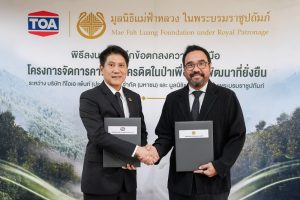
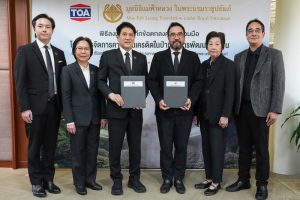
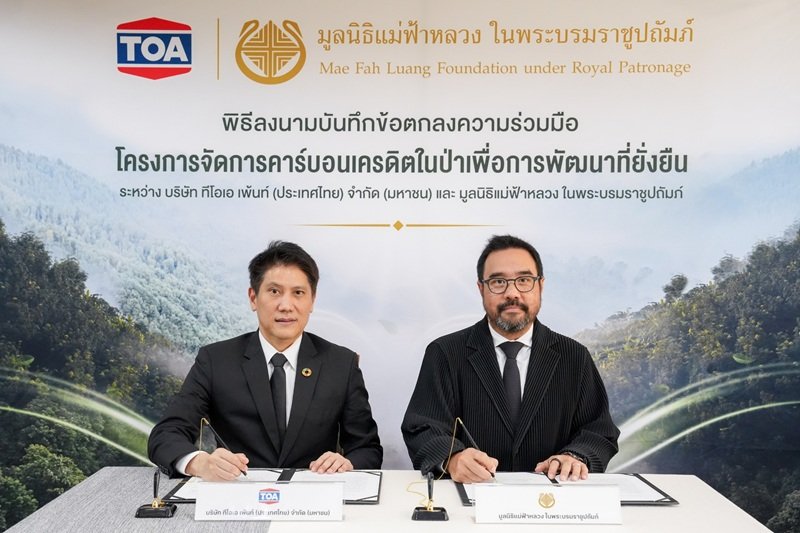
The memorandum of understanding was signed by Jatuphat Tangkaravakoon, Chief Executive Officer of TOA, and M.L. Dispanadda Diskul, Secretary-General and Chief Executive Officer of the Mae Fah Luang Foundation under Royal Patronage.
The signing was witnessed by Wipada Nakpairat, Vice President of the SHE & Quality Management and Sustainability Division; Noppakhun Panyasermsuk, Head of Marketing at TOA Paint (Thailand) Public Company Limited; and Smitthi Harueanphuech, Chief Nature Based Solutions Officer at the Mae Fah Luang Foundation.
The ceremony was held at the Mae Fah Luang Foundation’s Bangkok office.
Mr Jatuphat said the partnership reflected TOA’s commitment to conducting business alongside tangible environmental action.
The company gives as much importance to developing natural carbon sinks as it does to reducing greenhouse-gas emissions from its business operations, he said.
TOA believes that meeting climate targets requires action on both sides of the equation — reducing emissions and removing greenhouse gases from the atmosphere.
Since 2023, TOA has been restoring forest areas in Loei and Udon Thani provinces under its “TOA Loves Us, Loves the Planet — Restoring Forests and Ecosystems Sustainably” initiative.
The initiative seeks to expand green areas, restore biodiversity and rebuild healthy ecosystems, while encouraging local communities to participate in managing their natural resources.
The partnership with the Mae Fah Luang Foundation represents another important step in strengthening TOA’s Green Reforestation strategy, one of the seven pillars of its Green Mission policy.
The strategy supports the company’s goal of achieving net-zero greenhouse-gas emissions by 2050 by increasing carbon-dioxide absorption capacity and helping restore the balance of Thailand’s ecosystems.
“For TOA, reforestation is not simply about increasing the number of trees. It is an investment in creating sustainable ecosystems for the country,” Mr Jatuphat said.
He added that the project’s central objective went beyond restoring forests and expanding carbon sinks. It also sought to establish a sustainable balance between people and forests, allowing both to grow and support one another.
TOA also aims to create shared value for participating communities by encouraging local people to take part in managing and protecting natural resources.
The project will support livelihoods and generate income through environmentally responsible activities. This is intended to improve people’s quality of life, strengthen grassroots economies and provide long-term incentives for communities to conserve forest resources.
The approach is expected to support sustainable growth shared by businesses, communities and the environment.
M.L. Dispanadda said the partnership with TOA provided further evidence that Thailand’s private sector could make a tangible contribution to tackling climate change.
Drawing on the experience accumulated through the Doi Tung Development Project, an area for royal development in Chiang Rai, the Forest Carbon Credit Management for Sustainable Development Project addresses more than climate mitigation.
It also improves the quality of life of local communities and contributes to biodiversity conservation in community forests.
M.L. Dispanadda said the project’s success depended on strong cooperation between the Foundation and private-sector partners such as TOA, which recognised the importance of national environmental challenges and shared the belief that people and nature could genuinely thrive together.
The Mae Fah Luang Foundation advances sustainable development through four interconnected areas of work.
The first is area-based development, which adopts an integrated approach to improving community well-being.
The second is social enterprise, which creates stable livelihoods and sustainable income through the DoiTung brand.
The third is Nature-based Solutions, which improve community livelihoods while protecting and restoring natural resources.
The fourth is sustainability advisory services, through which the Foundation applies knowledge gained from practical field experience to collaborations with other organisations, generating measurable positive impacts at a broader scale.
The partnership with the Mae Fah Luang Foundation marks another important step in TOA’s journey towards net zero.
It also reinforces the role of the private sector in restoring healthy ecosystems, reducing the impacts of climate change and preserving abundant natural resources for future generations.